Full Menu / Blog / Coffee vs Espresso
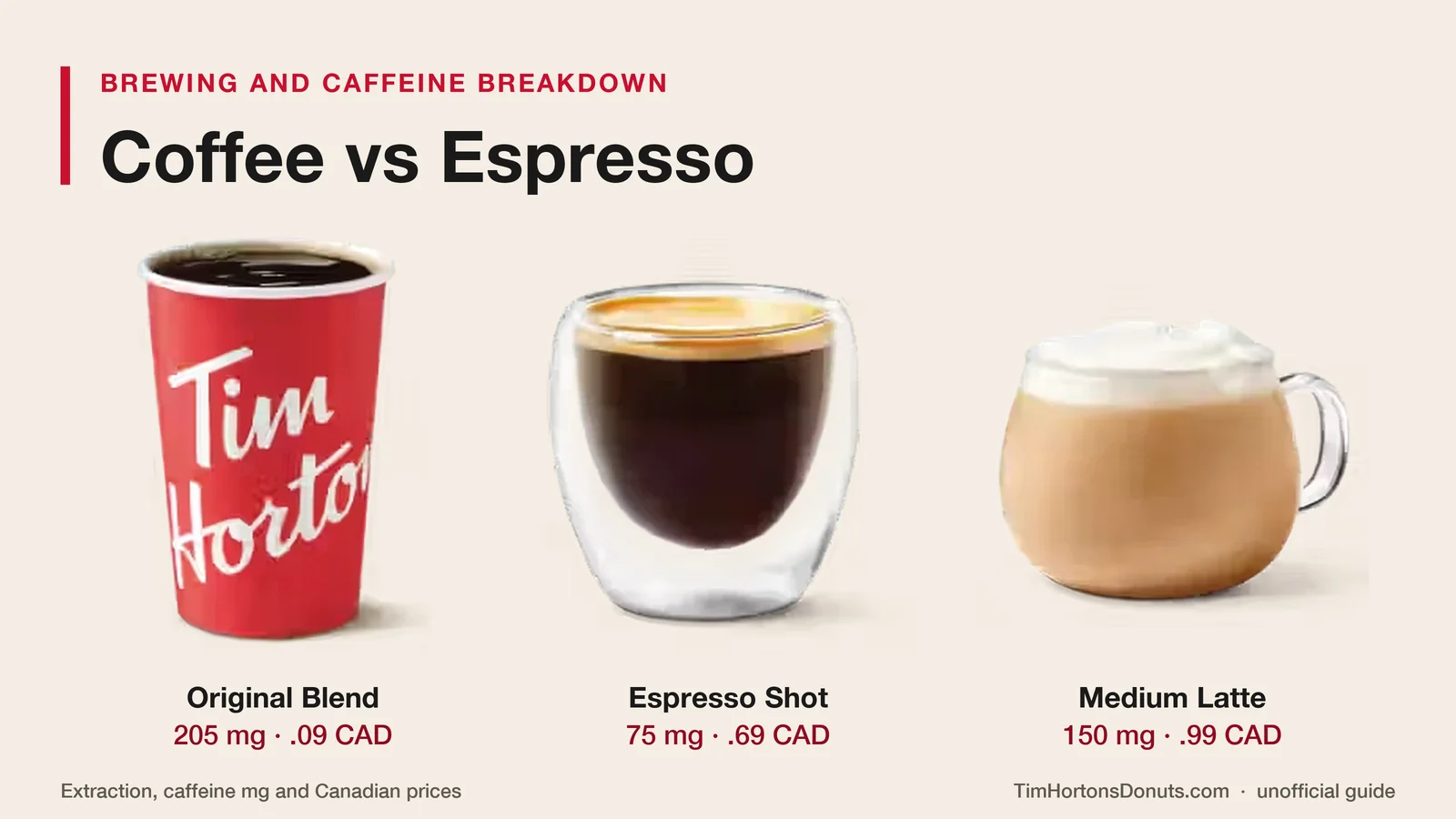
Tim Hortons brewed coffee is a gravity-percolated drip coffee made from medium or dark roast Arabica grounds, delivering a smooth, high-volume cup with 140 to 330 mg of caffeine. Tim Hortons espresso uses 9-bar pressure extraction to pull a concentrated 1.5-ounce shot with dense crema and approximately 125 mg of caffeine.
Whether you are pulling through the morning drive-thru or placing a mobile counter order, choosing between a standard cup of brewed coffee and an espresso beverage changes everything from your caffeine intake to your wallet. While both beverages start with 100% Arabica beans, their brewing physics, flavor density, and recipe versatility create two entirely distinct coffeehouse experiences.
---
What Is the Difference Between Tim Hortons Brewed Coffee and Espresso?
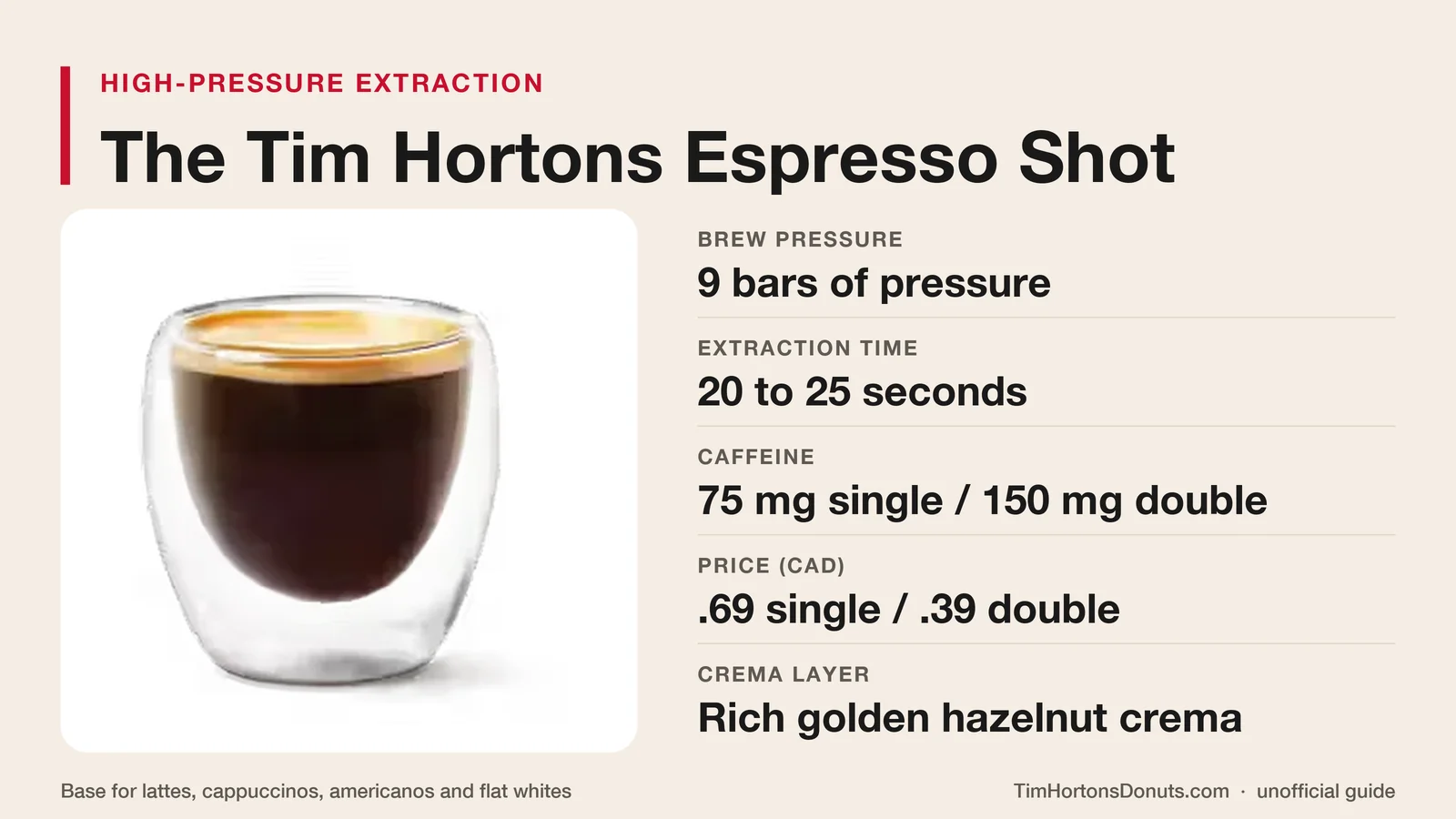
Tim Hortons brewed coffee relies on passive, gravity-fed hot water dripping through a filter basket over several minutes, whereas Tim Hortons espresso uses mechanical high pressure to force near-boiling water through a tightly packed puck of finely ground coffee in under thirty seconds. This fundamental mechanical difference defines their texture, extraction speed, and chemical balance.
```
+-------------------------------------------------------------------------+
| TIM HORTONS COFFEE VS ESPRESSO EXTRACTION |
|---|
+-------------------------------------------------------------------------+
| DRIP BREWED COFFEE ESPRESSO EXTRACTION | ||
|---|---|---|
| [Hot Water Reservoir (92-96°C)] [Pressurized Pump (~9 Bar)] | ||
| v v | ||
| [Gravity Shower Head] [High-Pressure Group Head] | ||
| v v | ||
| [Pre-Ground Medium Arabica Pouch] [Fresh Whole Beans Hopper] | ||
| [Paper Filter Basket] [Fine Grind Compact Puck] | ||
| (Contact Time: 3-5 min) (Contact Time: 25-30 sec) | ||
| v v | ||
| [Drip Carafe: 10 to 24 oz Pot] [Dense Shot: 1.5 oz with Crema] |
+-------------------------------------------------------------------------+
```
Brewing Mechanics: Gravity Drip vs 9-Bar Pressure Extraction
The primary mechanical distinction is atmospheric pressure. Tim Hortons prepares its traditional drip coffee using commercial batch brewers (such as Bunn industrial systems). Hot water heated between 92°C and 96°C disperses across a wide paper filter containing pre-measured grounds. Water trickles through purely by gravity, taking 3 to 5 minutes to complete a multi-serving pot. This long contact time washes soluble flavors gently from medium-coarse grounds, yielding a light-bodied, clean liquid free of heavy particulate matter.
In contrast, Tim Hortons espresso is extracted using commercial super-automatic espresso machines equipped with internal rotary pumps. The machine grinds whole espresso beans immediately on demand, tamps them into an internal brewing chamber, and forces water at approximately 9 bar (130 pounds per square inch) through the compressed puck. This intense pressure emulsifies insoluble coffee oils into a rich, golden micro-foam known as crema. The resulting 25-to-30-second extraction produces a syrupy, concentrated 1.5-ounce (44 mL) shot packed with suspended solids and volatile aromatics.
Bean Sourcing and Roast Profiles: Original Blend, Dark Roast, and Espresso Beans
Tim Hortons sources 100% Arabica coffee beans grown in prominent growing regions across Central and South America, roasted and blended to rigid corporate specifications. However, the roast levels and packaging methods differ significantly between the drip carafes and the espresso hoppers.
For standard brewed coffee, restaurant teams open pre-ground, nitrogen-flushed foil packets formulated for either the classic Original Blend (a balanced medium roast) or the Dark Roast (roasted deeper for lower perceived acidity and smoky cocoa undertones). In contrast, espresso machines feature clear overhead hoppers filled with whole beans. These espresso beans undergo a specialized roast profile optimized for pressurized extraction, highlighting caramelized sugars and minimizing harsh sour notes under high pressure. Because espresso beans are ground seconds before pulling the shot, espresso captures a distinct freshness profile compared to pre-ground drip pouches.
---
Caffeine Comparison: Which Delivers a Stronger Boost?
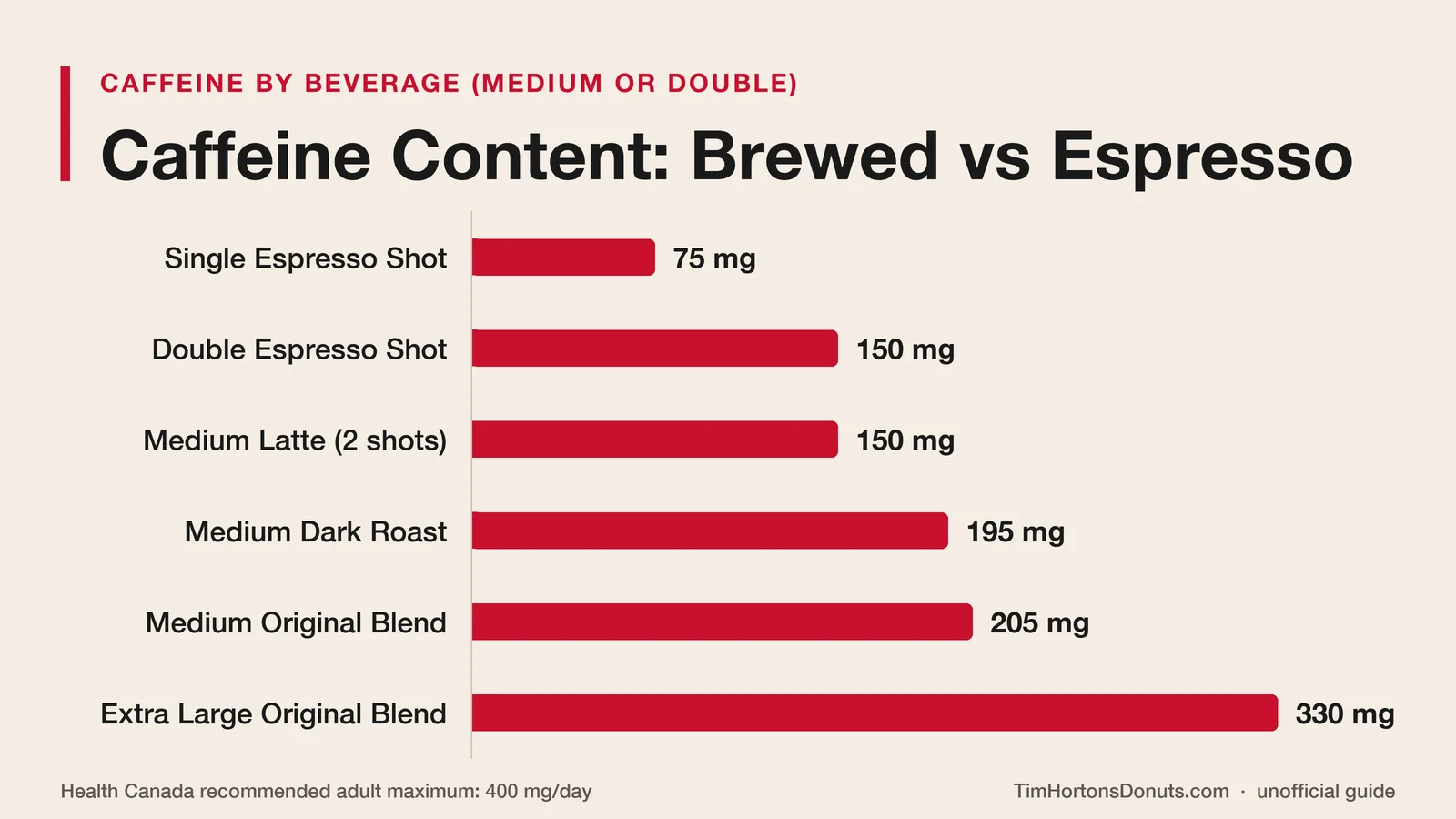
A medium 14-ounce Tim Hortons brewed coffee provides 205 mg of caffeine, whereas a single 1.5-ounce shot of Tim Hortons espresso provides approximately 125 mg of caffeine. Ounce for ounce, espresso is far more concentrated, but a standard mug of brewed coffee delivers a noticeably higher total caffeine dose due to its larger serving volume.
| Beverage & Size | Liquid Serving Size (oz / mL) | Total Caffeine (mg) | Caffeine per Ounce (mg/oz) |
|---|---|---|---|
| Single Espresso Shot | 1.5 oz / 44 mL | ~125 mg | 83.3 mg/oz |
| Double Espresso Shot | 3.0 oz / 88 mL | ~250 mg | 83.3 mg/oz |
| Brewed Coffee - Small | 10 oz / 284 mL | 140 mg | 14.0 mg/oz |
| Brewed Coffee - Medium | 14 oz / 414 mL | 205 mg | 14.6 mg/oz |
| Brewed Coffee - Large | 20 oz / 591 mL | 270 mg | 13.5 mg/oz |
| Brewed Coffee - Extra Large | 24 oz / 710 mL | 330 mg | 13.8 mg/oz |
| Dark Roast - Medium | 14 oz / 414 mL | 195 mg | 13.9 mg/oz |
| Decaf Coffee - Medium | 14 oz / 414 mL | ~9 mg | 0.6 mg/oz |
| Hot Latte - Medium | 14 oz / 414 mL | ~205 mg (2 shots) | 14.6 mg/oz |
| Americano - Medium | 14 oz / 414 mL | ~205–250 mg (2 shots) | 14.6–17.8 mg/oz |
Caffeine Content by Cup Size and Shot Count (The Milligram Breakdown)
Tim Hortons brewed coffee caffeine scales progressively with cup volume. A Small (10 oz) contains 140 mg, a Medium (14 oz) carries 205 mg, a Large (20 oz) delivers 270 mg, and an Extra Large (24 oz) delivers a massive 330 mg of caffeine. The Dark Roast features slightly lower caffeine metrics—measuring roughly 195 mg in a medium cup—because prolonged roasting breaks down a minuscule fraction of bean density.
On the espresso side, caffeine output is dictated entirely by shot counts rather than liquid cup dimensions. A single standalone shot contains roughly 125 mg. When you order milk-based handcrafted espresso beverages, Tim Hortons automatically calibrates shot counts to cup sizes. A Small latte generally incorporates one shot (125 mg), while Medium and Large lattes incorporate a double shot (delivering roughly 205 to 250 mg of caffeine depending on automated volumetric calibration).
Concentration vs Total Volume: Why Drip Coffee Often Wins
Confusion often arises because people equate "strength" with caffeine content. Espresso is undeniably stronger in caffeine density, boasting roughly 83 mg of caffeine per fluid ounce compared to drip coffee's 14 mg per fluid ounce. However, people rarely sip a 1.5-ounce espresso over a 45-minute commute.
Because commuters finish a full 14-ounce or 20-ounce paper cup of drip coffee, they absorb between 205 mg and 270 mg of total stimulant. If you order a small latte expecting an intense energy spike, you receive only a single espresso shot cushioned in 8 ounces of steamed milk—leaving you with 15 mg less total caffeine than you would receive from Tim Hortons' smallest 10-ounce drip cup.
---
Flavor Profile and Mouthfeel: Smooth Drip vs Concentrated Crema
Tim Hortons brewed coffee provides a thin, light-bodied mouthfeel with clean, toasted grain notes designed for effortless daily sipping, while Tim Hortons espresso offers a thick, velvety texture crowned with golden crema, pronounced bittersweet cocoa, and roasted nut undertones.
```
+--------------------------------------------------------------------+
| TASTE PROFILE & TEXTURE COMPARISON |
|---|
+--------------------------------------------------------------------+
| ATTRIBUTE BREWED COFFEE (DRIP) ESPRESSO SHOT |
|---|
| Acidity Crisp, mild, citrus hint Very low, rounded |
| Dominant Notes Toasted cereal, nut, oak Dark cocoa, molasses |
| Bitterness Gentle, smooth finish Sharp, concentrated |
| Crema Layer None (paper filtered) Thick golden micro-foam |
| Dairy Synergy Blends cleanly w/ cream Emulsifies velvety milk |
+--------------------------------------------------------------------+
```
Original Blend and Dark Roast Taste Notes
The flagship Original Blend is deliberately engineered for high drinkability and broad appeal. It offers a medium body, low to moderate acidity, and subtle notes of toasted walnut, caramel malt, and light brown sugar. Because the paper filter absorbs bean lipids, the finish is crisp and leaves no oily coating on the palate.
The Dark Roast introduces a deeper char profile. It delivers a fuller body, virtually zero perceived acidity, and dark bakers' chocolate and cedar wood notes. It was introduced to cater to drinkers who found the Original Blend too light, particularly when paired with rich dairy or sweet flavour syrups.
Tim Hortons Espresso Flavor Notes and Crema Characteristics
Espresso pulled from Tim Hortons super-automatic machines delivers a punchy sensory impact. The top layer features a golden-hazelnut crema created by trapped carbon dioxide bubbles suspended in aromatic oils. Beneath the crema lies a dense, full-bodied liquid with deep dark chocolate, molasses, and roasted almond notes.
Drank straight as a solo shot, it presents a sharp, bittersweet bite that can taste intense or astringent to those accustomed to mellow drip brews. However, this high concentration is precisely what allows the coffee essence to cut cleanly through thick steamed dairy in lattes and cappuccinos without tasting watery.
---
Menu Versatility: Handcrafted Espresso Drinks vs Traditional Drip Orders
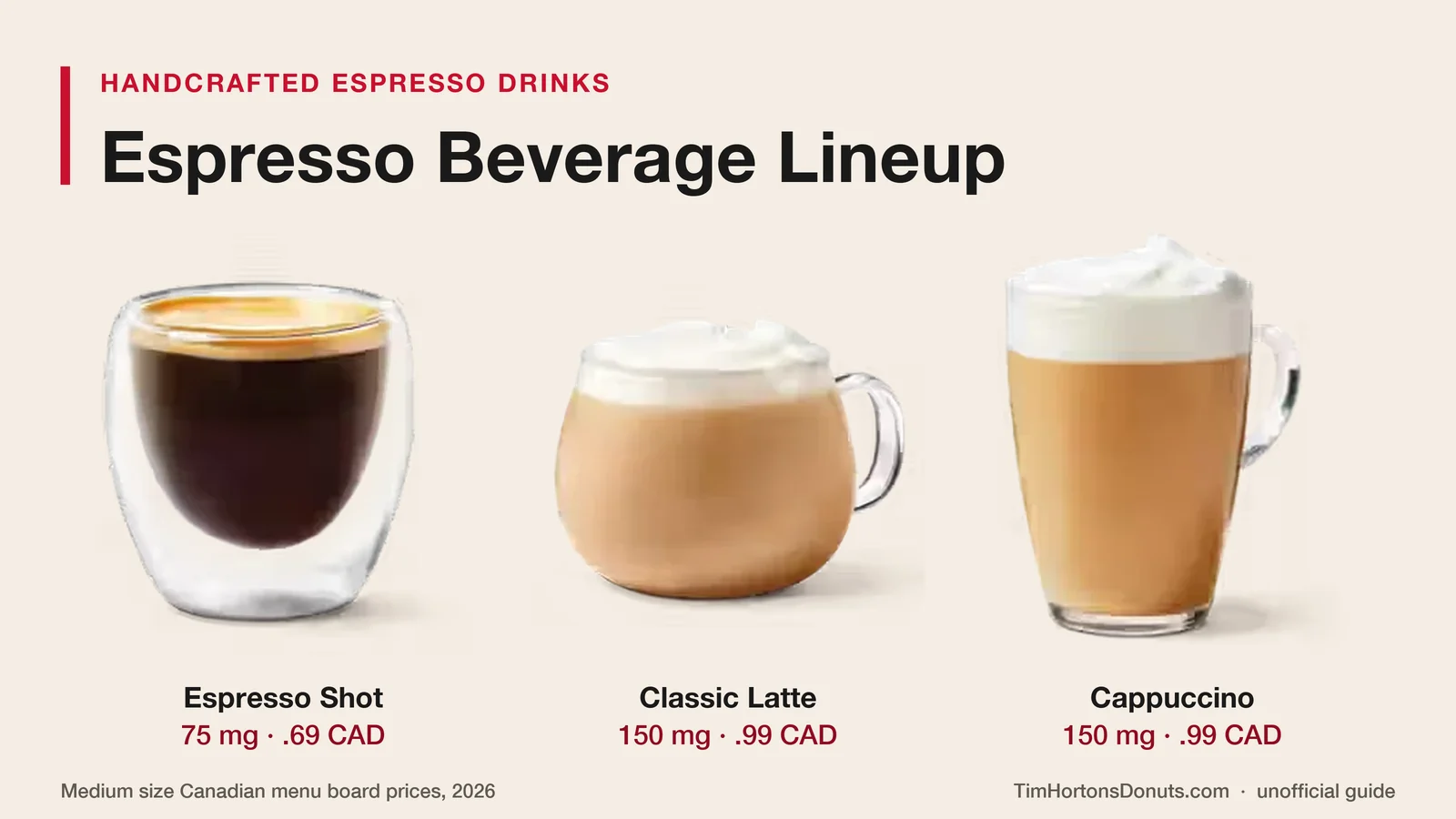
Tim Hortons uses its brewed coffee as a ready-to-pour standalone beverage customized primarily with cream and sugar, whereas its espresso serves as an adaptable concentrate used to construct Americanos, lattes, cappuccinos, flat whites, and specialty mochas.
Americano vs Brewed Black Coffee: Which Should You Pick?
An Americano consists of two freshly pulled espresso shots diluted with steaming hot water, whereas brewed black coffee is extracted directly as a single volume through a paper filter. While both result in a dark, diluted cup of black coffee, their taste profiles diverge sharply.
Because the Americano's espresso base bypasses paper filtration, small traces of emulsified coffee oils pass into the cup, providing a velvety texture and a faint residual crema on top. Many coffee enthusiasts prefer the Americano because it is pulled fresh on demand from whole beans, avoiding the "cooked" or burnt taste that can occasionally affect batch-brewed drip carafes that sit on heating elements past their prime 20-minute pot freshness window. If you want a cleaner, bolder cup of black coffee with zero bitterness, an Americano is your best counter choice.
Lattes and Cappuccinos: The Milk and Micro-Foam Factor
Brewed coffee is traditionally served with cold dairy poured straight from refrigerated dispensers. A Canadian staple, the famous Double-Double, blends medium drip coffee with two shots of rich 18% table cream and two teaspoons of granulated sugar, creating a pale, sweet, silky beverage.
In contrast, lattes and cappuccinos pair espresso with mechanically aerated, heated milk:
- Latte: Combines espresso with approximately 80% steamed milk and a thin layer of micro-foam, creating a smooth, milk-forward morning drink.
- Cappuccino: Features a 1:1:1 ratio of espresso, steamed milk, and thick, stiff dairy foam, offering an airy texture and a more pronounced coffee punch.
Tim Hortons allows you to customize these handcrafted drinks with whole milk, 2% dairy, skim milk, or plant-based alternatives like oat beverage and almond beverage.
---
Price and Value Comparison: Canadian Menu Pricing (CAD)
Tim Hortons brewed coffee remains one of the most affordable fast-food beverages in Canada, costing between $1.59 CAD and $2.35 CAD ($0.10 to $0.16 CAD per fluid ounce), whereas espresso beverages range from $2.79 CAD for an Americano to $3.99 CAD for specialty lattes ($0.20 to $0.29 CAD per fluid ounce).
| Menu Item | Size (Volume) | Average Price (CAD) | Cost per Fluid Ounce (CAD) |
|---|---|---|---|
| Brewed Coffee (Original / Dark) | Small (10 oz) | $1.59 | $0.16 / oz |
| Brewed Coffee (Original / Dark) | Medium (14 oz) | $1.83 | $0.13 / oz |
| Brewed Coffee (Original / Dark) | Large (20 oz) | $2.09 | $0.10 / oz |
| Brewed Coffee (Original / Dark) | Extra Large (24 oz) | $2.35 | $0.10 / oz |
| Single Espresso Shot | Solo (1.5 oz) | $1.49 – $1.79 | $1.00 – $1.19 / oz |
| Caffè Americano | Medium (14 oz) | $2.79 | $0.20 / oz |
| Classic Latte | Medium (14 oz) | $3.69 | $0.26 / oz |
| Classic Cappuccino | Medium (14 oz) | $3.69 | $0.26 / oz |
| Flavoured Latte (Vanilla/Caramel) | Medium (14 oz) | $3.99 | $0.29 / oz |
| Espresso Shot Add-On (to any drink) | 1 Shot (1.5 oz) | +$0.80 – $1.00 | N/A |
*Note: Pricing reflects representative Canadian franchise averages as of 2026. Local provincial taxes and regional store price variances apply.*
For everyday morning value, brewed drip coffee is unmatched. A 20-ounce Large coffee costs just $2.09 CAD ($0.10 per ounce), supplying 270 mg of caffeine. An espresso-based latte costs nearly double at $3.69 CAD for 14 ounces ($0.26 per ounce), reflecting the additional labor, fresh bean grinding, and steamed milk required.
---
Calories and Nutrition: Black Coffee, Dairy, and Espresso Beverages
Unsweetened brewed coffee and straight espresso shots are virtually calorie-free (2 to 5 calories per serving). Calorie disparities emerge entirely from how dairy fats and sweeteners are incorporated.
- Black Brewed Coffee or Straight Espresso: 2 to 5 kcal, 0 g fat, 0 g sugar.
- Brewed Coffee with 2% Milk (Regular - 1 milk, 1 sugar): ~45 kcal, 1 g fat, 6 g sugar.
- Medium Double-Double (2 Cream, 2 Sugar): ~210 kcal, 14 g fat (from 18% table cream), 22 g sugar.
- Medium Americano (Black): ~5 kcal, 0 g fat, 0 g sugar.
- Medium Latte (2% Dairy Milk): ~140–160 kcal, 6 g fat, 12 g natural lactose sugars.
- Medium Latte (Oat Milk): ~170–190 kcal, 5 g fat, 14 g carbohydrates.
If your primary nutritional objective is avoiding added sugars while maintaining a creamy texture, an unsweetened whole milk latte provides natural dairy sweetness and protein without the heavy saturated fat of Tim Hortons 18% table cream.
---
How to Customise Your Order: From the "Red Eye" to Dairy Swaps
You do not have to choose strictly between drip coffee and espresso. Tim Hortons point-of-sale systems allow cross-menu customizations that blend both brewing worlds.
```
+--------------------------------------------------------------------+
| ORDER CUSTOMIZATION BLUEPRINT |
|---|
+--------------------------------------------------------------------+
| THE DRINK GOAL HOW TO ORDER AT THE COUNTER |
|---|
| Rich Black Coffee Medium Americano (Hot water + Espresso) |
| Low-Acid Creamy Option Medium Dark Roast with 1 Oat Milk |
| High Protein Afternoon Medium Latte with 2% Milk (No Sugar) |
| Cold Caffeine Heavyweight Medium Original Cold Brew + Espresso Shot |
+--------------------------------------------------------------------+
```
The "Red Eye" or Turbo Coffee
If a standard brewed coffee does not provide enough morning energy, order a "Medium regular coffee with an added shot of espresso" (often referred to by baristas as a Red Eye or Turbo shot). For an extra $0.80 to $1.00 CAD, the team member pulls a fresh 125 mg espresso shot directly into your 205 mg drip coffee mug, creating a 330 mg powerhouse with intensified cocoa depth.
Dairy and Sweetener Customizations
You can substitute standard 18% table cream or 2% homogenized cow's milk with Chobani oat beverage or Silk almond beverage across all hot and cold drinks. For espresso drinks, you can also request extra shots or sugar-free flavor syrup pumps.
To explore the broader beverage catalog, view our full Tim Hortons coffee menu, check out the dedicated handcrafted espresso lineup, read our review of the classic Tim Hortons latte, or explore chilled alternatives in our Original Cold Brew guide. For pantry brewing, consult our breakdown of retail Tim Hortons coffee bean varieties, or review macro nutrition across drinks with our Tim Hortons beverage calorie breakdown.
---
Which Should You Order? A Quick Decision Guide
Use this simple decision checklist to match your drink order to your routine:
- Order Brewed Coffee (Original Blend or Dark Roast) if:
- You want the highest total caffeine boost per dollar spent.
- You love the nostalgic Canadian "Double-Double" flavour profile.
- You prefer a large, steaming 20-ounce cup to sip slowly during a lengthy drive or workday.
- You want the fastest drive-thru service during peak morning rush hours.
- Order an Espresso Beverage (Americano, Latte, or Cappuccino) if:
- You want coffee ground fresh from whole beans on demand.
- You prefer thick, velvety micro-foam milk textures rather than cold cream.
- You enjoy a concentrated, bold cocoa flavor with zero paper filter sediment.
- You want an Americano for a clean black coffee that never tastes burnt or stale.
---
Frequently Asked Questions
Does Tim Hortons regular coffee have more caffeine than an espresso shot?
Yes, a standard cup of Tim Hortons regular brewed coffee contains more total caffeine than a single espresso shot. A medium 14-ounce brewed coffee delivers approximately 205 mg of caffeine, whereas a single 1.5-ounce shot of espresso delivers about 125 mg. However, espresso has a much higher caffeine concentration per fluid ounce (roughly 83 mg/oz compared to 14.6 mg/oz in brewed coffee).
Can I add a shot of espresso to my Tim Hortons brewed coffee?
Yes, you can add an espresso shot to any hot or iced brewed coffee at Tim Hortons by requesting a shot add-on at the register or through the mobile app. This combination is commonly called a "Red Eye" or "Turbo Coffee" and costs an additional $0.80 to $1.00 CAD, raising the caffeine count of a medium coffee to roughly 330 mg.
What is the difference between a Tim Hortons Americano and regular black coffee?
A Tim Hortons Americano is made by pulling fresh espresso shots and diluting them with hot water, whereas regular black coffee is brewed by slowly dripping water through medium coffee grounds in a batch paper filter. The Americano has a fuller mouthfeel with light surface crema because the espresso machine grinds whole beans on demand and allows aromatic coffee oils to pass through without paper filtration.
Does Tim Hortons use real espresso machines?
Yes, Tim Hortons uses commercial super-automatic espresso machines equipped with built-in conical burr grinders and internal pressure pumps. These automated machines grind whole espresso beans fresh for each order, tamp the grounds, and pull shots at approximately 9 bar of pressure before automatically steaming and frothing milk for lattes and cappuccinos.
Are Tim Hortons espresso beans different from their Original Blend coffee beans?
Yes, Tim Hortons uses a dedicated espresso bean blend that differs from its packaged Original Blend and Dark Roast drip grounds. While both use 100% Arabica beans, the espresso blend features a distinct roast profile engineered to produce dense golden crema, balanced sweetness, and low acidity under high-pressure extraction.
How much does an extra espresso shot cost at Tim Hortons in Canada?
An extra single shot of espresso at Tim Hortons restaurants in Canada costs between $0.80 CAD and $1.00 CAD, depending on the province and specific store location. You can add extra shots to lattes, iced coffees, brewed coffees, or cold brews.
Which has fewer calories: a regular coffee or an espresso?
Both a black regular coffee and a straight espresso shot have virtually identical nutritional profiles, containing between 2 and 5 calories with zero grams of fat and sugar. However, espresso-based lattes and cappuccinos contain significantly more calories (140 to 190 kcal) due to steamed milk, whereas brewed coffee calories depend entirely on how much cream or sugar you add.
Why does Tim Hortons drip coffee taste different from an Americano?
Tim Hortons drip coffee tastes lighter and crisper because it passes through a paper filter that traps natural coffee oils and fine sediment, while brewing under passive gravity for several minutes. An Americano tastes bolder and silkier because high-pressure espresso extraction emulsifies coffee oils directly into the liquid without paper filtration, resulting in deeper caramelization and fuller body.
Does Tim Hortons offer decaf espresso?
Most Canadian Tim Hortons locations do not carry decaffeinated espresso beans in their super-automatic espresso hoppers, meaning drinks like lattes, Americanos, and cappuccinos are generally available only in regular caffeinated form. If you require decaf coffee, order the Decaf Brewed Coffee, which uses water-process decaffeinated grounds and contains around 6 to 9 mg of residual caffeine.
Is a Tim Hortons Latte stronger than a medium Double-Double?
In terms of total caffeine, a medium Tim Hortons latte (which contains two espresso shots) and a medium Double-Double brewed coffee are nearly identical, both delivering approximately 205 mg of caffeine. However, in terms of coffee flavor intensity, the latte tastes slightly bolder because the concentrated espresso cuts through steamed milk more distinctly than drip coffee balances with 18% table cream and sugar.
What kind of milk is used in Tim Hortons espresso drinks?
Tim Hortons defaults to 2% homogenized cow's milk for hot lattes, cappuccinos, and flat whites, but customers can request skim milk, whole milk, Chobani oat beverage, or Silk almond beverage. For brewed drip coffee, Tim Hortons defaults to rich 18% table cream unless milk or plant-based dairy is specifically requested.
This is an independent reference guide. TimHortonsDonuts.com is not affiliated with, endorsed by, or sponsored by Tim Hortons or Restaurant Brands International. Caffeine figures and brew specifications reflect official company reference data and Health Canada guidelines. See Sources.