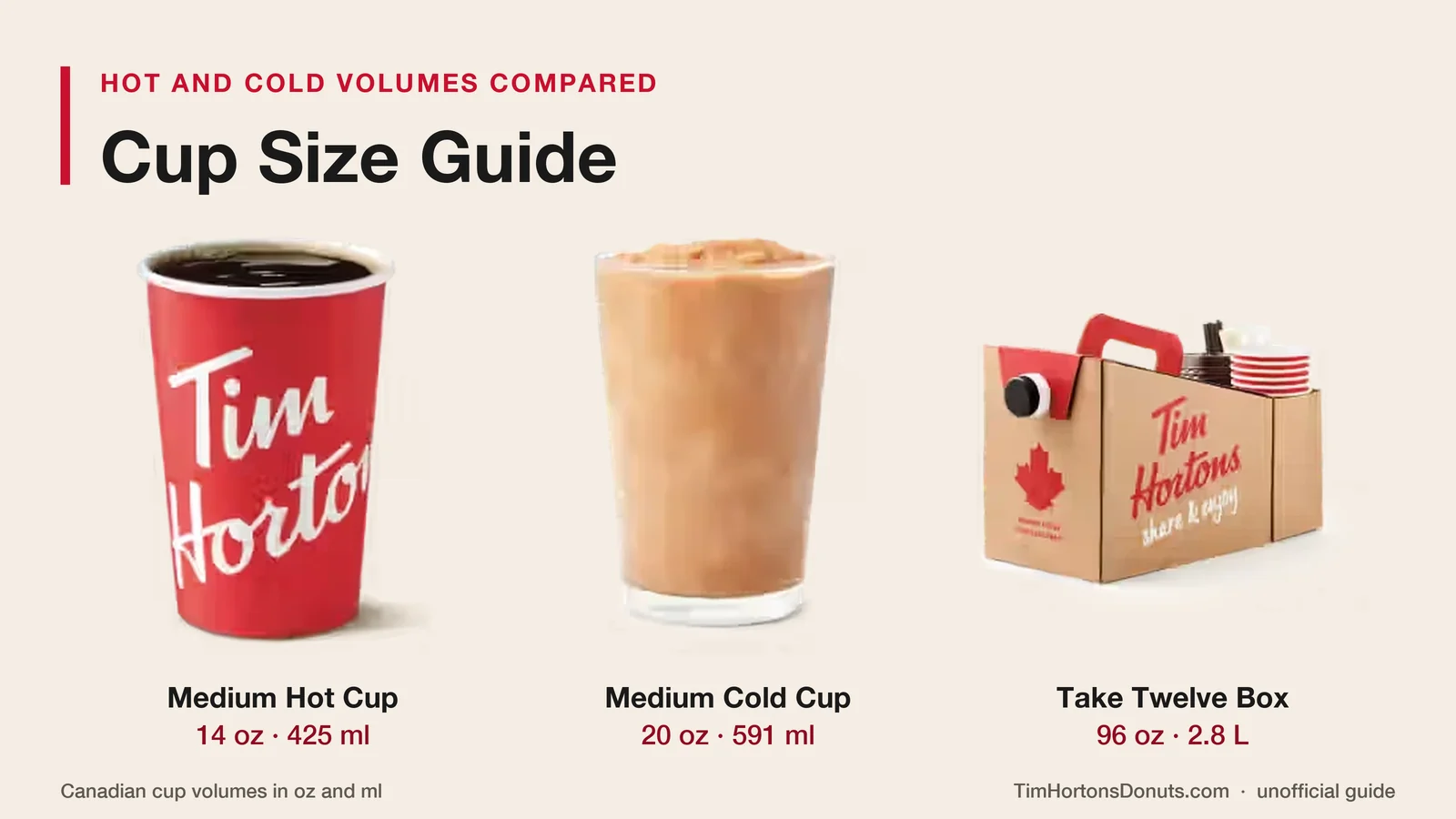
Tim Hortons serves five hot cup sizes: Extra Small (8 oz / 236 ml), Small (10 oz / 286 ml), Medium (14 oz / 425 ml), Large (20 oz / 568 ml), and Extra Large (24 oz / 710 ml). Cold drinks come in Small (15 oz), Medium (20 oz), and Large (24 oz) cups.
Tim Hortons Hot Cup Sizes: Quick Reference (Oz vs Ml)
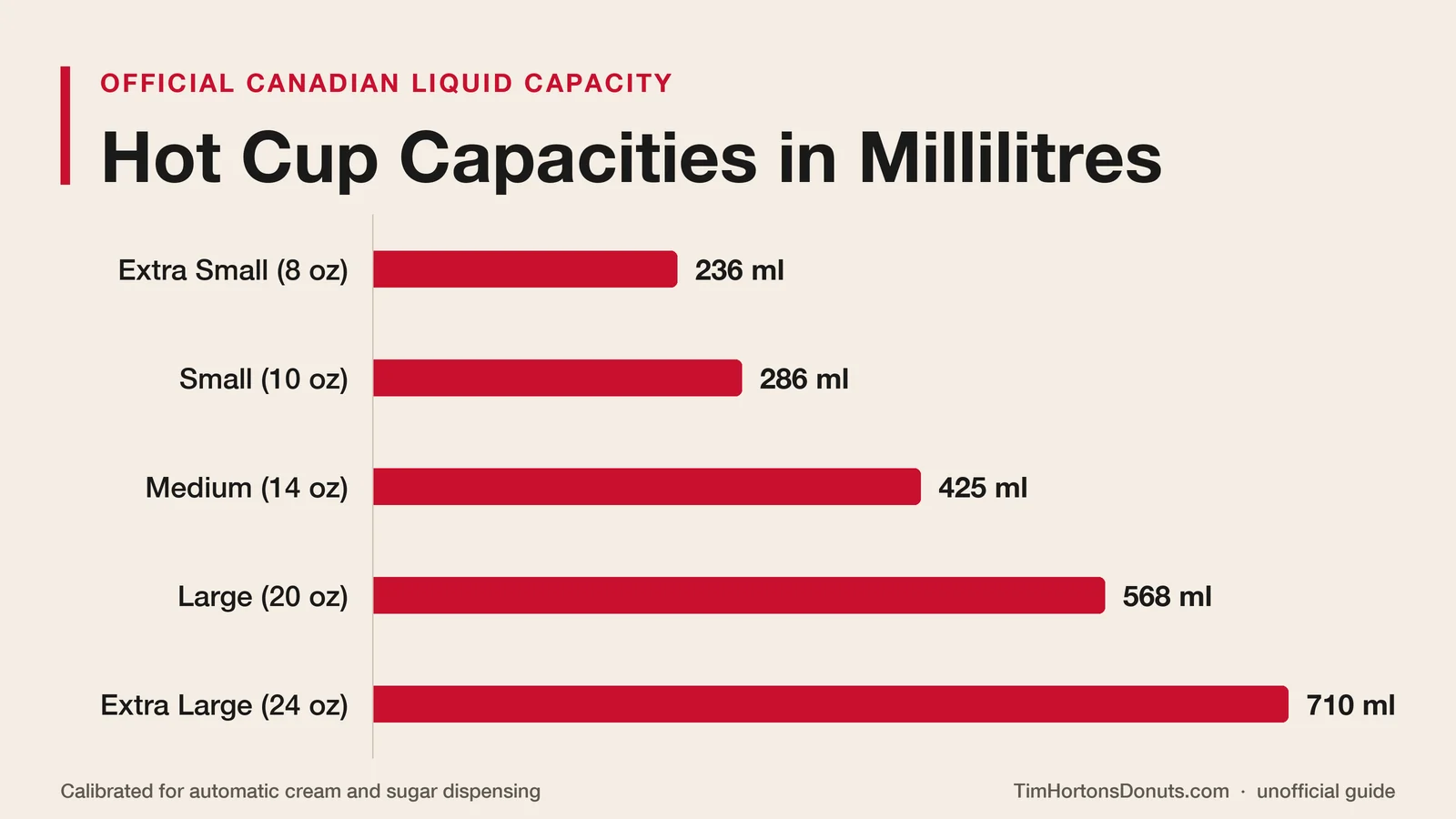
Tim Hortons hot cups are engineered for fresh-brewed coffee, steeped tea, hot chocolate, and specialty warm beverages. Across Canada, these paper cups adhere to strict volumetric calibrations to ensure precise automatic dairy and sweetener dispensing from the drive-thru to the counter.
Below is the complete volume specification for every standard hot beverage cup:
| Hot Cup Size | Fluid Ounces (fl oz) | Millilitres (mL) | Typical Beverage Use | Best For |
|---|---|---|---|---|
| Extra Small | 8 fl oz | ~236 mL | Espresso, Hot Chocolate, Kids' drinks | Quick caffeine hit, children, smaller appetite |
| Small | 10 fl oz | ~286 mL | Original Blend, Dark Roast, Steeped Tea | Traditional morning coffee, modest caffeine |
| Medium | 14 fl oz | ~425 mL | All brewed coffee, French Vanilla, Lattes | Daily commuters, standard Canadian order |
| Large | 20 fl oz | ~568 mL | Brewed coffee, Americano, Hot Tea | Extended work sessions, high-volume drinkers |
| Extra Large (XL) | 24 fl oz | ~710 mL | Brewed coffee, Steeped Tea, Americano | Long road trips, maximum daily caffeine |
Extra Small (8 oz / 236 ml)
An Extra Small Tim Hortons cup holds exactly 8 fluid ounces (236 millilitres) of liquid. It is the most compact paper cup in the chain's lineup, frequently chosen for specialty espresso drinks, rich hot chocolate, or when ordering warm beverages for young children.
Before 2012, this 8 oz container served as Canada's standard "Small" cup. Following public demand during the nationwide sizing overhaul, Tim Hortons retained the physical 8 oz cup under the Extra Small designation.
Small (10 oz / 286 ml)
A Small hot cup delivers 10 fluid ounces (286 millilitres) of beverage. While US measurement tables often round 10 fluid ounces to 295 millilitres, Canadian Tim Hortons packaging calibrates this volume to precisely 286 millilitres to match standardized dairy dispenser shots.
This size suits casual drinkers seeking a balanced morning cup of Tim Hortons brewed coffee menu selections without an overwhelming caffeine load.
Medium (14 oz / 425 ml)
A Medium Tim Hortons coffee cup holds 14 fluid ounces (425 millilitres) of liquid. Holding the title of Canada's most frequently ordered beverage size, the 14 oz cup represents the quintessential everyday coffee order.
The 14 oz capacity provides ample beverage volume while maintaining ideal thermodynamic retention, keeping your coffee hot from the first sip down to the bottom of the cup.
Large (20 oz / 568 ml)
A Large cup holds 20 fluid ounces (568 millilitres) of hot liquid, precisely matching one Imperial pint. Standard Canadian packaging prints this container capacity as 568 mL, catering to morning commuters facing extended drives or desk workers needing long-lasting warmth.
Because dairy and sugar pumps scale proportionately, ordering a "double-double" in a 20 oz cup delivers double the dairy volume of a 10 oz small to maintain the brand's classic flavor consistency.
Extra Large (24 oz / 710 ml)
The Extra Large hot cup contains a generous 24 fluid ounces (710 millilitres) of liquid. Standing as the largest single-serve hot container on the menu, this cup was added in 2012 to satisfy growing North American consumer demand for supersized coffee servings.
Delivering over 300 milligrams of caffeine in brewed coffee format, this size powers long-haul highway travel and demanding work shifts.
---
Tim Hortons Cold Cup Sizes: Iced Coffee and Iced Capp
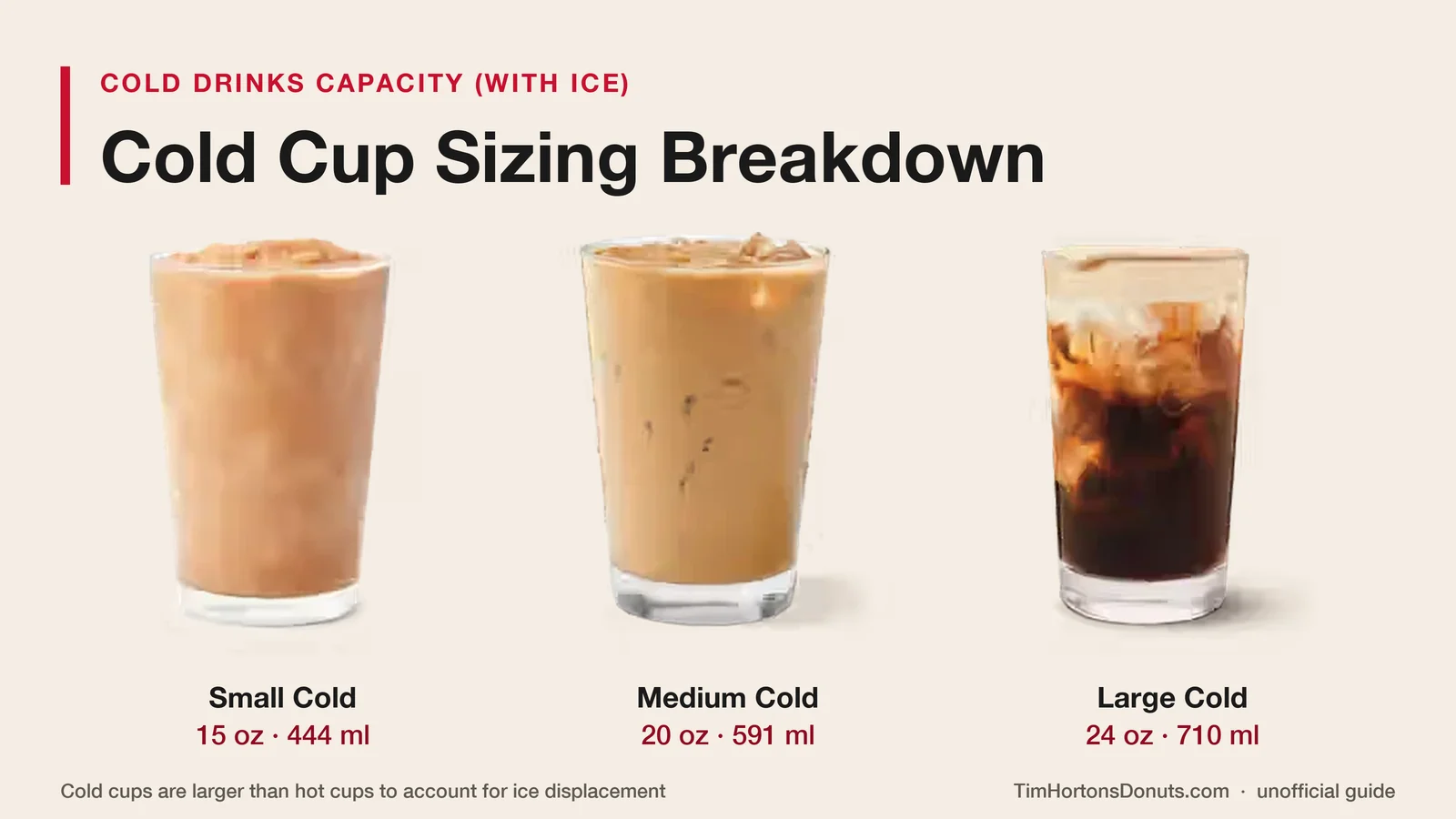
Cold drinks at Tim Hortons do not share the hot beverage cup inventory. Clear plastic cups are constructed with wider diameters, reinforced side walls, and specialized rims engineered to snap securely onto domed beverage lids or sip lids.
Crucially, cold drink sizes start at 15 fluid ounces—eliminating both the Extra Small and 10 oz Small formats found on the hot menu:
| Cold Cup Size | Fluid Ounces (fl oz) | Millilitres (mL) | Compatible Cold Drinks | Lid Style |
|---|---|---|---|---|
| Small | 15 fl oz | ~444 mL | Iced Coffee, Original Iced Capp, Cold Brew, Quenchers | Domed (blended) / Sip lid (iced) |
| Medium | 20 fl oz | ~591 mL | Iced Coffee, Original Iced Capp, Cold Brew, Quenchers | Domed (blended) / Sip lid (iced) |
| Large | 24 fl oz | ~710 mL | Iced Coffee, Original Iced Capp, Cold Brew, Quenchers | Domed (blended) / Sip lid (iced) |
Small Cold Cup (15 oz / 444 ml)
The Small cold cup holds 15 fluid ounces (444 millilitres), making it 50% larger in total container volume than a Small hot cup. This size serves as the baseline format for iced drinks, providing enough interior space to hold fresh liquid espresso or chilled coffee alongside ice cubes.
It represents the entry-level portion for an afternoon Original Iced Capp or sweet iced brew.
Medium Cold Cup (20 oz / 591 ml)
The Medium cold cup provides 20 fluid ounces (591 millilitres) of volume. Equal in external capacity to a Large hot cup, the 20 oz cold format accommodates the rich, slushy blend of coffee base and cream that defines the signature Iced Capp experience.
When ordering a flavored cold beverage with cold foam or chocolate whipped topping, the extra headroom inside the Medium cup accommodates rich layers without overflowing.
Large Cold Cup (24 oz / 710 ml)
The Large cold cup maxes out at 24 fluid ounces (710 millilitres). Matching the physical volume of an Extra Large hot cup, this size holds generous servings of refreshing Tim Hortons Original Iced Coffee or fruit-flavored Real Fruit Quenchers.
For warm summer days, the 24 oz container provides refreshing cold hydration that remains chilled across hours of outdoor activities.
---
The Ice Displacement Reality: How Much Liquid Do You Actually Get?
When ordering an iced beverage at Tim Hortons, the fluid ounce measurement stamped on the clear cup represents total container brim capacity—not the net volume of brewed liquid coffee. Understanding ice displacement explains why your 20 oz Medium iced coffee finishes faster than a 20 oz Large hot coffee.
Standard cup preparation fills plastic cups with approximately 30% to 35% solid crescent ice by volume before pouring the chilled coffee and dairy base:
| Advertised Cold Size | Container Capacity | Estimated Ice Displacement | Net Liquid Beverage (Actual) | Net Liquid Volume (mL) |
|---|---|---|---|---|
| Small Cold | 15 fl oz (444 mL) | ~4.5–5.0 fl oz | ~10.0–10.5 fl oz | ~295–310 mL |
| Medium Cold | 20 fl oz (591 mL) | ~6.0–7.0 fl oz | ~13.0–14.0 fl oz | ~385–414 mL |
| Large Cold | 24 fl oz (710 mL) | ~7.5–8.5 fl oz | ~15.5–16.5 fl oz | ~458–488 mL |
*(Note: Blended drinks like the Original Iced Capp incorporate crushed ice directly into the sweetened java base, yielding a frozen emulsion that fills the entire volume with uniform liquid density).*
Pro-Ordering Tip: If you want more liquid coffee in your iced order, request "light ice" at the drive-thru speaker. Baristas will reduce the ice scoop volume, allowing more chilled brewed coffee to fill the cup cavity.
---
Hot vs Cold Cups: Side-by-Side Comparison Table
To eliminate confusion between hot and cold ordering tiers, this side-by-side matrix illustrates how hot and cold drink formats compare across name, capacity, and liquid metrics:
| Size Name | Hot Cup Volume (Oz / mL) | Cold Cup Volume (Oz / mL) | Volume Discrepancy |
|---|---|---|---|
| Extra Small | 8 fl oz / 236 mL | *Not Available* | Hot menu exclusive |
| Small | 10 fl oz / 286 mL | 15 fl oz / 444 mL | Cold cup is +5 oz (+158 mL) larger |
| Medium | 14 fl oz / 425 mL | 20 fl oz / 591 mL | Cold cup is +6 oz (+166 mL) larger |
| Large | 20 fl oz / 568 mL | 24 fl oz / 710 mL | Cold cup is +4 oz (+142 mL) larger |
| Extra Large (XL) | 24 fl oz / 710 mL | *Not Available* | Matches Large Cold cup volume (24 oz) |
---
The 2012 Canadian Cup Resize: Why Tim Hortons Renamed Its Sizes
On January 16, 2012, Tim Hortons altered the morning routines of millions of Canadians by rolling out an across-the-board restructuring of cup names and volumes. To understand why modern cup names differ from 1990s nostalgia, look at how the entire lineup shifted downwards to accommodate a new 24 oz size:
| Pre-2012 Cup Name | Physical Cup Volume | Post-2012 (Current) Cup Name | Net Volume Change |
|---|---|---|---|
| *Did Not Exist* | 24 fl oz / 710 mL | Extra Large (XL) | Brand new size introduced |
| Extra Large | 20 fl oz / 568 mL | Large | Renamed to Large (volume unchanged) |
| Large | 14 fl oz / 425 mL | Medium | Renamed to Medium (volume unchanged) |
| Medium | 10 fl oz / 286 mL | Small | Renamed to Small (volume unchanged) |
| Small | 8 fl oz / 236 mL | Extra Small | Renamed to Extra Small (volume unchanged) |
Tim Hortons introduced this shift to match expanding beverage portions across competitor brands like Starbucks and McDonald's McCafé while standardizing container sizes across its expanding United States footprint.
Because the company retained the physical 8 oz cup as an Extra Small, longtime customers who prefer smaller, lower-calorie morning portions can still order their traditional 8 oz coffee.
---
Caffeine Content by Cup Size: Original Blend vs Dark Roast
Caffeine intake varies substantially across cup sizes and bean roast profiles. Contrary to common coffee folklore, darker roasted beans do not yield higher caffeine concentrations; the prolonged roasting process slightly degrades bean caffeine mass, giving the lighter Original Blend a subtle edge in stimulating power.
Review the caffeine concentrations across brewed hot coffee sizes:
| Cup Size | Total Volume | Original Blend Caffeine | Dark Roast Caffeine | Decaf Coffee Caffeine |
|---|---|---|---|---|
| Extra Small | 8 oz / 236 mL | ~110 mg | ~100 mg | ~4 mg |
| Small | 10 oz / 286 mL | ~140 mg | ~130 mg | ~6 mg |
| Medium | 14 oz / 425 mL | ~205 mg | ~195 mg | ~9 mg |
| Large | 20 oz / 568 mL | ~270 mg | ~260 mg | ~12 mg |
| Extra Large (XL) | 24 oz / 710 mL | ~330 mg | ~315 mg | ~15 mg |
Health Canada recommends limiting daily caffeine consumption to 400 mg for healthy adults. A single Extra Large cup (330 mg) provides over 80% of that recommended daily threshold, making a Medium (205 mg) or Small (140 mg) a safer baseline for individuals who enjoy multiple cups throughout the workday.
For an extensive analysis of calorie counts, dairy options, and syrup additions, explore our comprehensive nutritional and calorie breakdown.
---
Tim Hortons Cup Prices & Value Analysis: Cost Per Ounce (CAD)
Tim Hortons menu prices vary slightly across Canadian provinces and urban territories due to regional operating costs and provincial sales taxes. However, the price intervals between sizes follow a uniform mathematical value curve:
| Cup Size | Volume (fl oz) | Average In-Store Price (CAD) | Cost Per Fluid Ounce (CAD) | Relative Value Rating |
|---|---|---|---|---|
| Small | 10 fl oz | $1.59 CAD | $0.159 / oz | Baseline |
| Medium | 14 fl oz | $1.83 CAD | $0.131 / oz | 17.6% Cheaper per oz |
| Large | 20 fl oz | $2.07 CAD | $0.104 / oz | 34.6% Cheaper per oz |
| Extra Large | 24 fl oz | $2.35 CAD | $0.098 / oz | 38.4% Best Overall Value |
From a financial efficiency perspective, upgrading from a Small ($1.59) to an Extra Large ($2.35) costs only 76 cents more in Canadian currency while delivering 140% more coffee. If you drink coffee continuously throughout the morning, buying an Extra Large yields the lowest cost per fluid ounce on the entire hot beverage menu board.
---
Catering in Bulk: The Take Twelve Box (96 oz / 2.8 L)
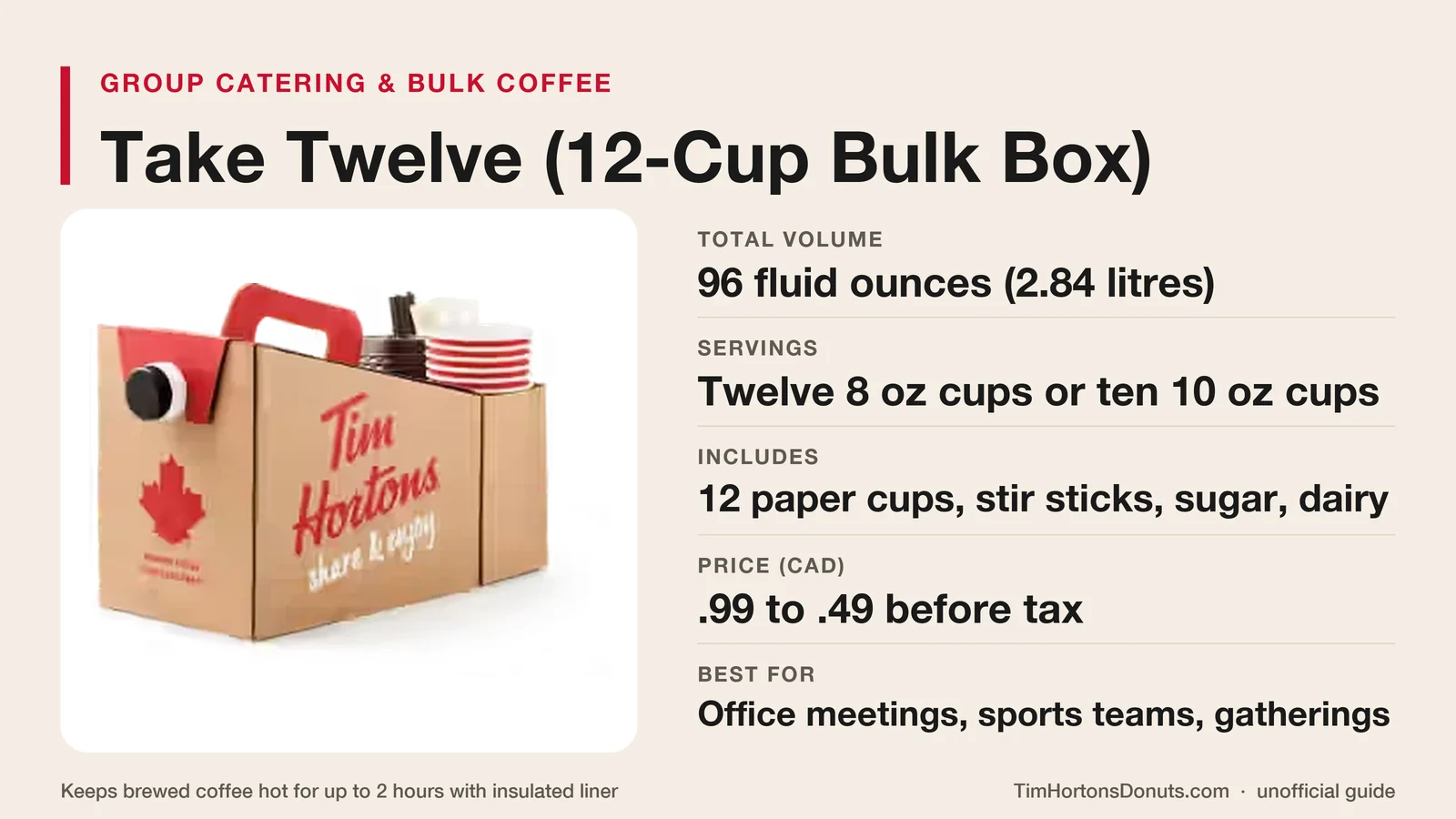
When organizing office meetings, family gatherings, or weekend sports tournaments, ordering individual single-serve cups is inefficient. The Take Twelve bulk catering box offers a commercial-grade bulk coffee solution designed for group convenience.
Inclusions and Liquid Capacity
- Total Fluid Volume: 96 fluid ounces (approximately 2.84 litres).
- Cup Servings: Engineered to pour twelve 8-ounce servings (or approximately nine to ten 10-ounce Small cups).
- Cardboard Packaging: Heavyweight corrugated exterior with an interior thermal bladder designed to retain serving temperatures for up to two hours.
- Accessory Kit: Every Take Twelve purchase includes 12 paper cups with matching travel lids, stir sticks, sugar and sweetener packets, and individual creamer cups.
Averaging between $19.99 CAD and $23.99 CAD depending on regional franchise location, the Take Twelve provides an economical, mess-free catering option for group breakfast functions.
---
Frequently Asked Questions
What are the Tim Hortons cup sizes in oz?
Tim Hortons hot cup sizes are Extra Small (8 oz), Small (10 oz), Medium (14 oz), Large (20 oz), and Extra Large (24 oz). Cold drink cups are sold in Small (15 oz), Medium (20 oz), and Large (24 oz).
How many ml is a medium Tim Hortons coffee?
A medium Tim Hortons hot coffee contains 425 millilitres (14 fluid ounces). In cold beverages, a medium cup holds 591 millilitres (20 fluid ounces).
Why did Tim Hortons change its cup sizes in 2012?
Tim Hortons updated its sizing on January 16, 2012, to introduce a brand-new 24 oz Extra Large cup. To fit the new size into the menu, previous sizes shifted down one tier: the 20 oz cup became Large, 14 oz became Medium, 10 oz became Small, and the original 8 oz cup was renamed Extra Small.
What size is a large iced coffee at Tim Hortons?
A large iced coffee at Tim Hortons is served in a 24 fluid ounce (710 millilitres) clear plastic cup. When packed with standard beverage ice cubes, it yields approximately 16 fluid ounces of liquid coffee.
Can you order an Extra Small cold drink at Tim Hortons?
No, Tim Hortons does not offer an Extra Small size for cold beverages. Cold drinks like Iced Capps and Iced Coffees are exclusively available in Small (15 oz), Medium (20 oz), and Large (24 oz).
How much coffee is in a Tim Hortons Take Twelve box?
A Tim Hortons Take Twelve box contains 96 fluid ounces (2.84 litres) of hot brewed coffee. This volume is calibrated to pour twelve 8-ounce cups or about nine 10-ounce small cups.
Which Tim Hortons cup size gives the best value for money?
The 24 oz Extra Large cup provides the best financial value at approximately $0.098 CAD per fluid ounce. By comparison, a 10 oz Small cup costs roughly $0.159 CAD per fluid ounce, making the Extra Large over 38% more economical per ounce.
Does Tim Hortons Dark Roast have more caffeine than Original Blend?
No, Tim Hortons Original Blend contains slightly more caffeine than Dark Roast across all sizes. A medium Original Blend has approximately 205 mg of caffeine, whereas a medium Dark Roast contains around 195 mg because longer roasting times diminish bean caffeine density.
How many ounces is an Extra Large Tim Hortons cup?
An Extra Large Tim Hortons hot cup contains 24 fluid ounces (710 millilitres). It is the largest single cup size served across Canadian locations.
How many millilitres are in a Tim Hortons small cup?
A Small hot cup holds 286 millilitres (10 fluid ounces), whereas a Small cold cup holds 444 millilitres (15 fluid ounces).
Do Tim Hortons cups fit standard car cup holders?
Yes, all Tim Hortons hot and cold cup bases are tapered to fit standard automotive cup holders. Even the 24 oz Extra Large cup features a narrow base profile specifically engineered to sit securely in standard vehicle consoles.
This size guide is an independent reference. Volumes in fluid ounces and millilitres reflect Canadian packaging standards. Ice displacement reduces liquid drink volume in cold cups. See Sources.