Full Menu / Blog / Caffeine Content
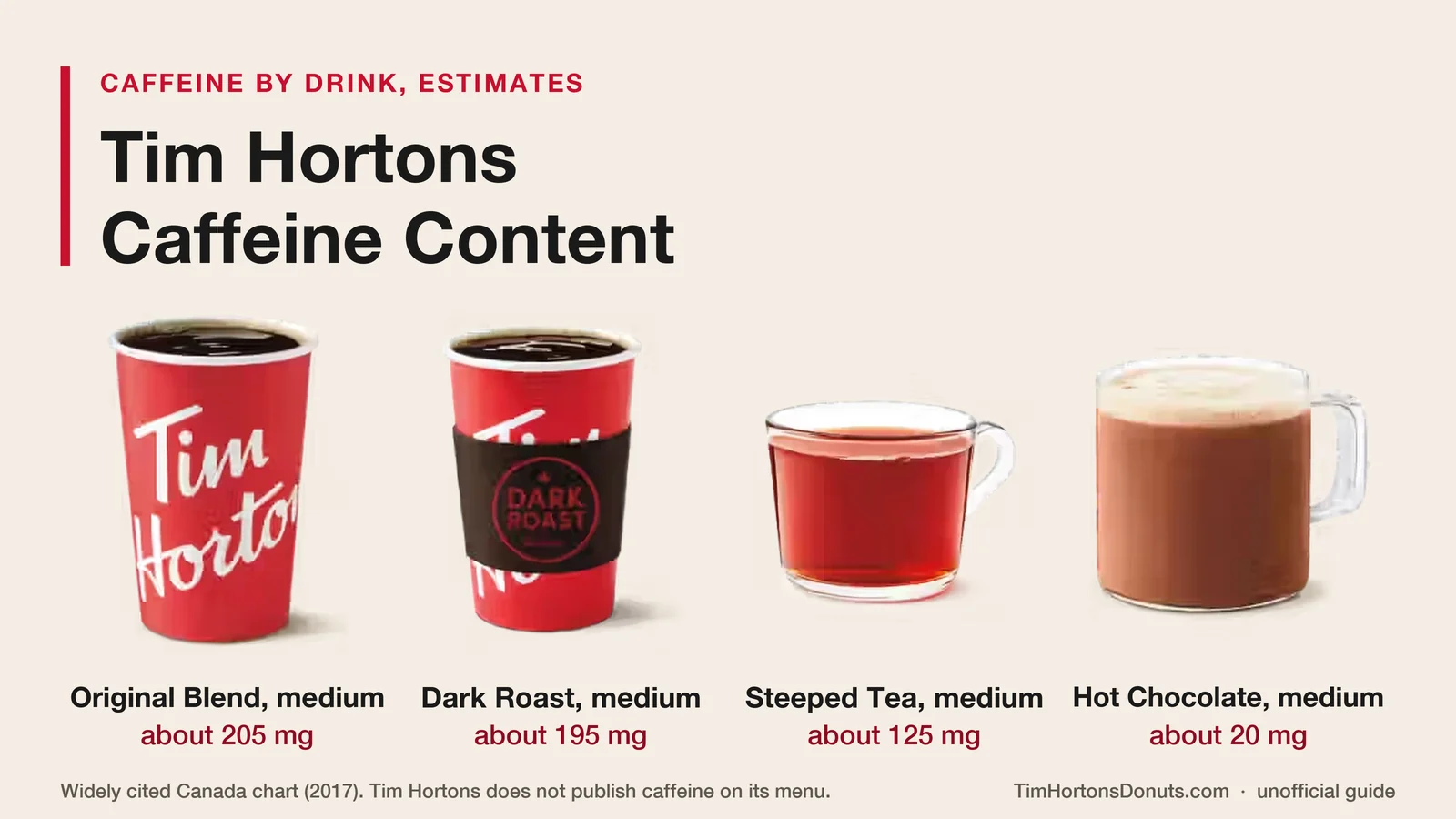
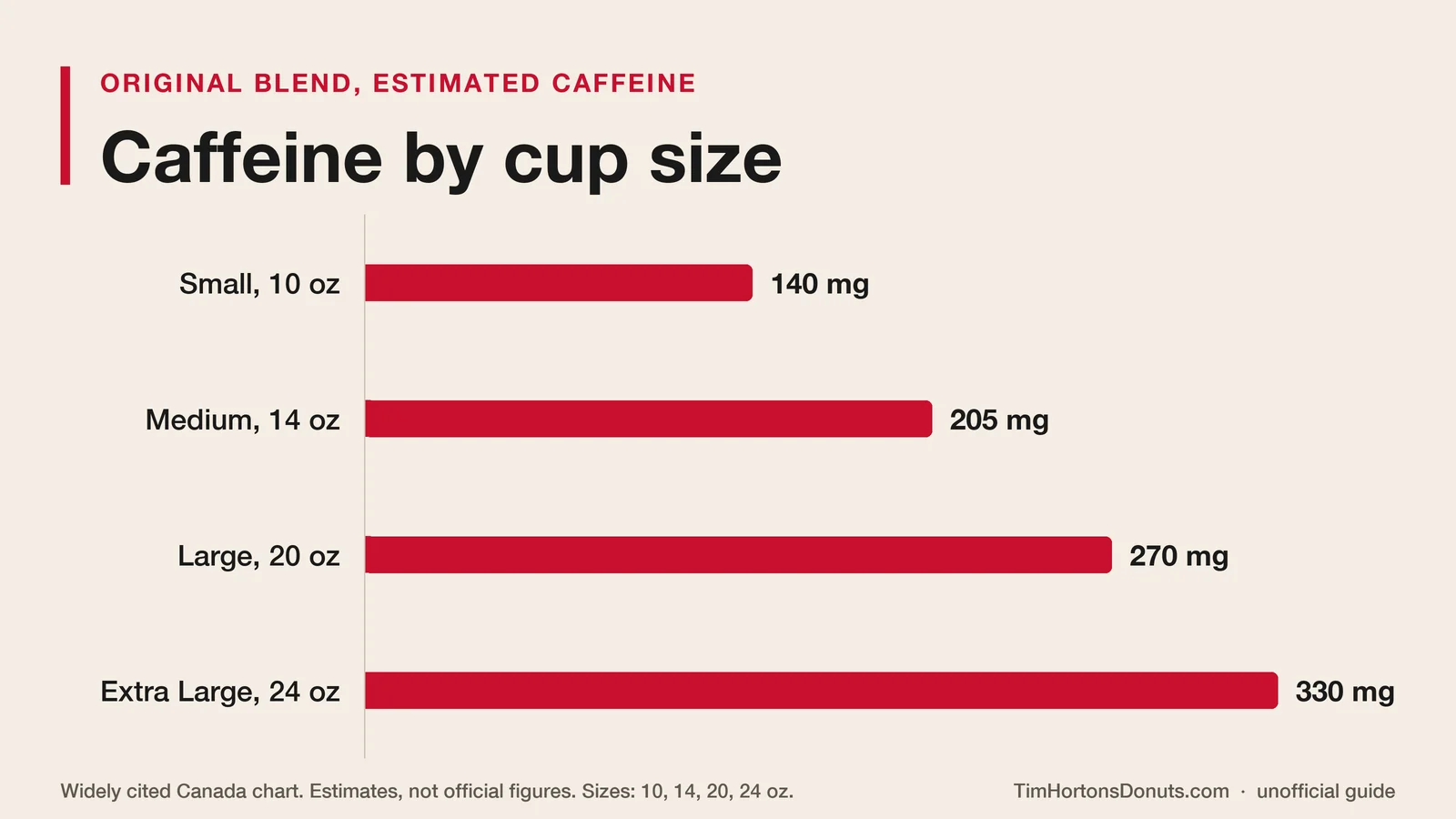
A medium Tim Hortons Original Blend coffee has about 205 mg of caffeine in a 14 oz (425 mL) cup. Tim Hortons does not publish caffeine figures on its menu, so this is a widely cited estimate. A small has about 140 mg, a large 270 mg and an extra large 330 mg.
How Much Caffeine Is in a Tim Hortons Coffee?
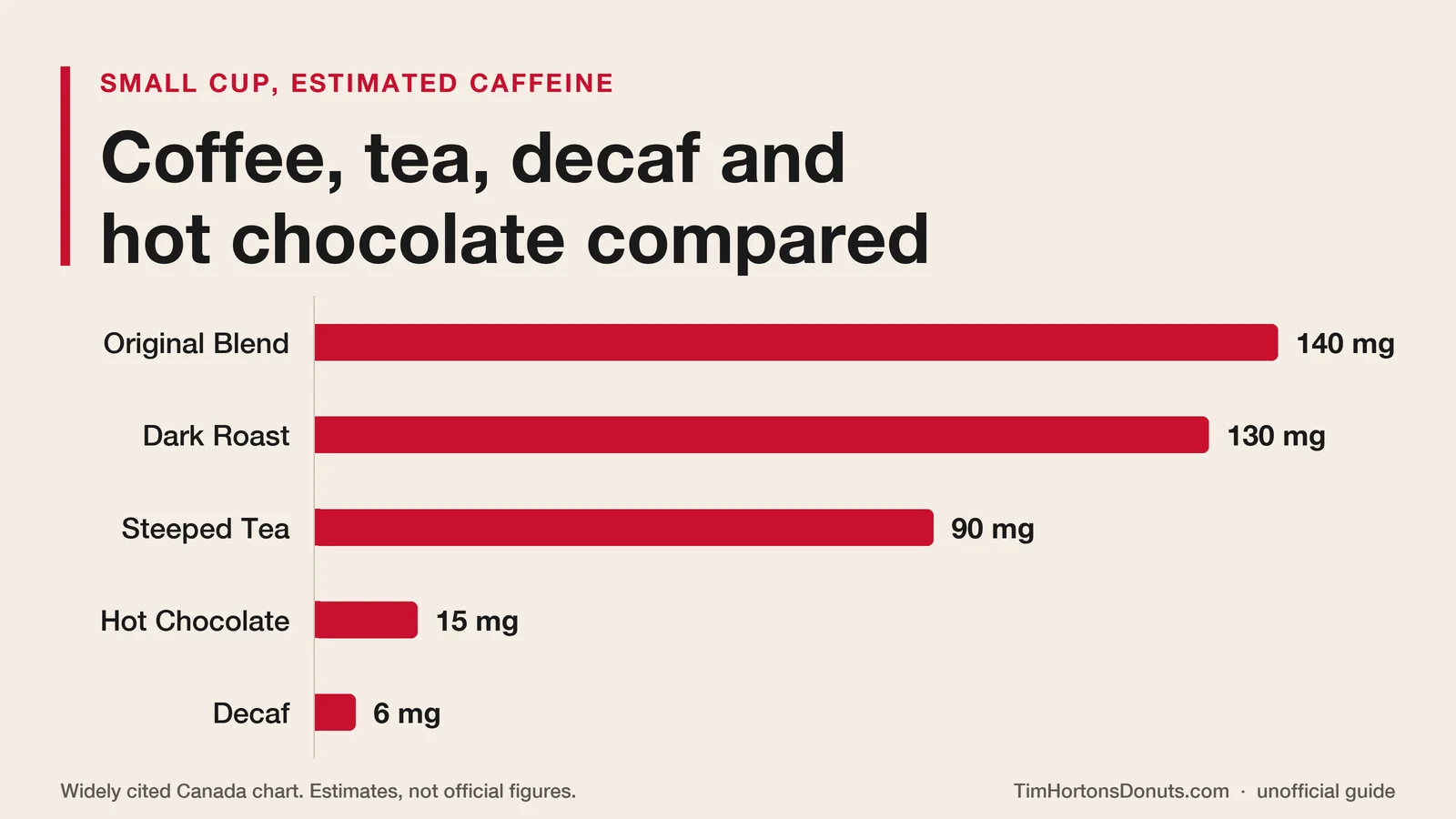
Brewed coffee has 140 to 330 mg of caffeine, depending on the size and the roast. These are the figures most sites repeat, and our next section explains where they come from. Sizes are from our size guide.
| Cup size | Original Blend | Dark Roast | Decaf |
|---|---|---|---|
| Small, 10 oz (286 mL) | 140 mg | 130 mg | 6 mg |
| Medium, 14 oz (425 mL) | 205 mg | 195 mg | 9 mg |
| Large, 20 oz (568 mL) | 270 mg | 260 mg | 12 mg |
| Extra Large, 24 oz (710 mL) | 330 mg | 315 mg | 15 mg |
How Many Ounces Is a Medium Tim Hortons Coffee?
A medium is 14 oz, or 425 mL. The small is 10 oz (286 mL), the large 20 oz (568 mL) and the extra large 24 oz (710 mL). The caffeine rises with the cup, but the amount per ounce stays close to 14 mg: Original Blend works out to 14.0 mg per ounce in a small and 13.8 in an extra large.
Does Dark Roast or Decaf Have Less Caffeine?
Dark Roast has slightly less than Original Blend, about 10 mg less in a small. Decaf is not caffeine-free: it has 6 to 15 mg because decaffeination removes most of the caffeine, not all. For a lower-caffeine cup with the same flavour range, see the brewed coffee and dark roast pages.
Does Tim Hortons Publish Its Caffeine Numbers?
No. Tim Hortons' Help Centre says to contact its Guest Care Team, choose "General Inquiry" and then "Nutrition/Ingredients", and staff will answer caffeine questions. The caffeine figures on most websites trace back to a Tim Hortons chart for Canada only, dated 2017. A copy is hosted on a health team's site, so the numbers are about nine years old, and some sites say the underlying data were published in 2008.
That matters for two reasons. The recipes and cup sizes may have changed, and the chart predates newer drinks such as protein lattes. Treat every figure here as an estimate, and use Guest Care if you need an exact number for a health reason.
How Much Caffeine Is in Tim Hortons Tea and Hot Chocolate?
Steeped tea has 90 to 210 mg and hot chocolate has 15 to 35 mg, according to the same chart. The table lists the four sizes.
| Drink | Small | Medium | Large | Extra Large |
|---|---|---|---|---|
| Steeped Tea | 90 mg | 125 mg | 175 mg | 210 mg |
| Hot Chocolate | 15 mg | 20 mg | 30 mg | 35 mg |
Bagged teas are lower: chai and black bagged tea are listed at 50 mg in a small and 170 mg in an extra large, and green bagged tea at 25 to 60 mg. Tim Hortons notes that tea caffeine varies with steeping time.
How Much Caffeine Is in an Espresso Shot, a Latte or an Iced Capp?
Sources disagree, so we cannot give a single number. The same site's Canada and US tables contradict each other, and other pages give a third figure. The table shows the spread:
| Drink | Figures found | Why it is not a fact |
|---|---|---|
| Espresso shot | 45 mg, 75 mg and 125 mg | Different pages give different numbers |
| Medium latte | 50 mg (US table) and 205 mg (Canada table) | Same site, two answers |
| Medium Iced Cappuccino | About 120, 140 and 205 mg | No two sources match |
| Medium iced coffee | 130 mg (Canada table) and 170 mg (US table) | Same site, two answers |
If you want the comparison of espresso and brewed coffee, read our coffee vs espresso guide. The calories for these drinks are on the calories page, where Tim Hortons does publish them.
How Much Caffeine Is Too Much?
Health Canada recommends no more than 400 mg a day for adults, and no more than 300 mg for people who are planning pregnancy, pregnant or breastfeeding. For children and teens it uses 2.5 mg for each kilogram of body weight. Health Canada also lists 135 mg as typical for an 8 oz (237 mL) cup of brewed coffee.
Tim Hortons coffee comes in larger cups than 8 oz, so one order can be a big share of the limit. The table shows brewed Original Blend against both limits:
| Cup size | Caffeine | Share of 400 mg | Share of 300 mg |
|---|---|---|---|
| Small | 140 mg | 35% | 47% |
| Medium | 205 mg | 51% | 68% |
| Large | 270 mg | 68% | 90% |
| Extra Large | 330 mg | 83% | 110% |
An extra large Original Blend is above the 300 mg limit on its own. If you are pregnant or sensitive to caffeine, ask your doctor, not a menu site, for your own limit.
How Can You Order Less Caffeine at Tim Hortons?
Pick a smaller cup, switch to Dark Roast or decaf, or choose a hot chocolate. Cream and sugar do not change the caffeine, but they change the calories: see the Double Double guide and Iced Capp calories. A small decaf has about 6 mg, and a small hot chocolate has about 15 mg, against 140 mg for a small Original Blend. Check the best Tim Hortons drinks for lighter picks, and the size guide before you order.
Frequently Asked Questions
How much caffeine is in a medium Tim Hortons coffee?
About 205 mg for a 14 oz Original Blend. Dark Roast is about 195 mg, and decaf is about 9 mg.
How much caffeine is in a small Tim Hortons coffee?
About 140 mg for a 10 oz Original Blend, according to the widely cited chart. Dark Roast is about 130 mg.
How much caffeine is in a large Tim Hortons coffee?
About 270 mg for a 20 oz Original Blend, which is about 68 percent of Health Canada's 400 mg adult limit.
How much caffeine is in an extra large Tim Hortons coffee?
About 330 mg for a 24 oz Original Blend. That is above the 300 mg limit for pregnancy and breastfeeding.
Which Tim Hortons coffee has the most caffeine?
The extra large Original Blend, at about 330 mg. Among the brewed coffees, Original Blend has slightly more than Dark Roast at every size.
Does Tim Hortons decaf have caffeine?
Yes, a small amount. Decaf is listed at 6 mg in a small and 15 mg in an extra large, because decaffeination does not remove all of it.
Is 200 mg of caffeine a lot?
It is about half of Health Canada's 400 mg daily limit for adults, so it is a moderate amount. A medium Tim Hortons coffee is about 205 mg.
How many Tim Hortons coffees can I drink a day?
Health Canada's 400 mg limit equals just under two medium coffees (205 mg each). Other drinks, tea and chocolate also count toward the total.
How much caffeine is in a Tim Hortons espresso shot?
Sources give 45, 75 and 125 mg, so there is no reliable single figure. Tim Hortons does not publish it.
How much caffeine is in a Tim Hortons hot chocolate?
About 15 mg in a small up to 35 mg in an extra large, much less than coffee. It is made with cocoa, not coffee.
Where can I find Tim Hortons' official caffeine information?
Tim Hortons' Help Centre says to contact the Guest Care Team and select "General Inquiry", then "Nutrition/Ingredients". The menu itself does not list caffeine.
Why do different sites list different caffeine amounts?
Most copy the same older chart, and some mix US and Canadian tables or add their own estimates. For a few drinks, such as espresso and iced coffee, the numbers genuinely conflict.
This is an independent guide, not affiliated with Tim Hortons or Restaurant Brands International. Tim Hortons does not publish caffeine figures on its menu; the numbers here come from a widely cited Canada chart dated 2017 and are estimates. Daily limits are from Health Canada. This is not medical advice. See Sources.